

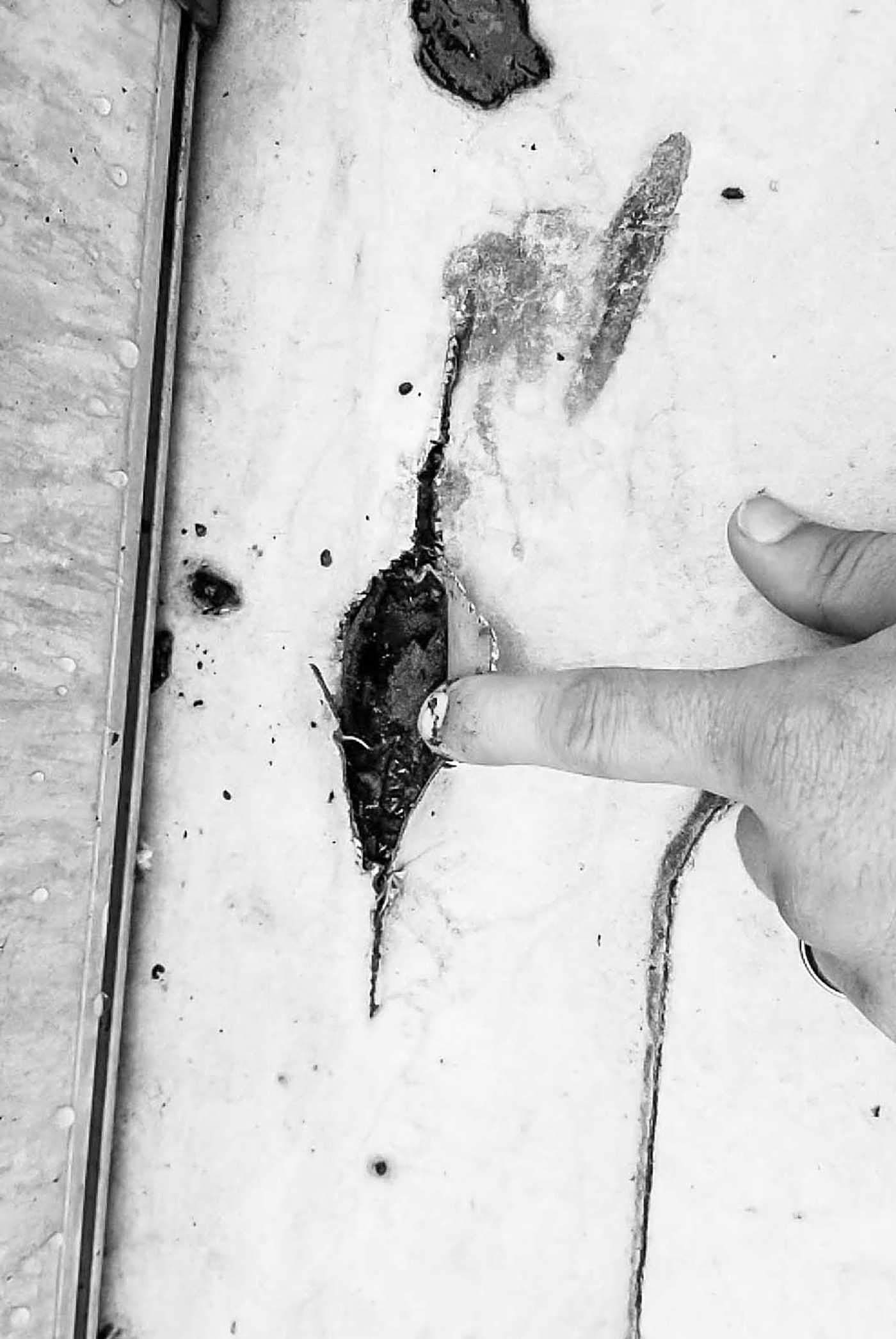
What does hail damage on a roof look like?
On a composition roof it looks like a dark, soft circle roughly the size of a coin where the granules have been knocked away, and pressing it feels like a bruise on fruit because the fiberglass mat underneath has fractured. From the ground it is invisible. What you can see from a driveway is soft metal: dents in the gutters, the downspouts, the vent caps and the fins of the air conditioner. If those are dented, the roof took the same stones.
A bruise is a fracture, not a dent
The damage a hailstone does to an asphalt shingle happens under the surface. The stone hits hard enough to crack the fiberglass mat in the body of the shingle without punching through it, and it knocks the protective granules off the spot where it landed. What is left is a circle that looks darker than the shingle around it and gives slightly under a thumb.
That matters because the granules are the sunscreen. Once they are gone, ultraviolet light is working directly on the asphalt at that spot, and the crack in the mat gives water a path. The roof does not leak the week after the storm. It leaks in a few years, by which point the claim window has closed.
What you can check from the ground
Soft metal tells the story. Gutters and downspouts dent visibly. So do the aluminum fins on the outdoor unit of the air conditioner, the caps on the roof vents, the mailbox and the garage door. Painted surfaces on the elevation that faced the storm chip. Window screens tear.
Wind is the other half of a Texas thunderstorm and it leaves a different sign: shingles along a rake or ridge that have broken their seal strip without coming off the roof. From the ground the roof looks untouched. On a windy day you may see a course lift and drop.
If any of that is present, the roof is worth having looked at. Not because it definitely has damage, but because the stones that dented the gutter went over the roof on the way.
How an adjuster measures it, and why you want the same format
An adjuster does not eyeball a roof. They mark out a test square, usually ten feet by ten, on each slope, find the impacts inside it, circle them in chalk and count them. The count per square against the carrier’s threshold is what decides whether the slope is repairable or has to be replaced. Whether damage appears on every slope or only the one facing the storm matters too.
Which is the argument for having the roof documented in that format before the adjuster arrives. Two people looking at the same marked square on the same day agree far more often than two people comparing reports a fortnight later.
The date on the storm is part of the claim
Texas policies commonly require a loss to be reported within a set period after it occurs, and the date that counts is the date of the storm rather than the date you noticed the ceiling stain. Hail damage that sat undiscovered for three years is routinely denied as wear, and it looks like wear by then, because three more summers have worked on the exposed asphalt.
This is the practical reason to get a dated, photographed report after a storm even when you expect the answer to be no. If a later storm adds to it, you have a baseline.
Related questions
How big does hail have to be to damage a roof?
It depends on the age and type of the roof and on wind speed, but roughly one inch is where carriers start expecting damage on composition. Smaller stones driven hard can still break the seal on an old brittle roof.
Should I climb up and look myself?
Better not to. Walking a roof damages it, especially tile and slate, and identifying a bruise takes a practiced hand. That is what the free inspection is for.
The neighbors are all getting new roofs. Does that mean I need one?
It means the storm passed over your street, which is a reason to have yours looked at. Damage varies slope by slope and house by house, so a neighbor’s claim is evidence, not an answer.