

Should I put TPO, PVC or modified bitumen on my flat roof?
TPO is the default for most North Texas commercial buildings: a welded single-ply sheet, usually white, and the reflectivity cuts cooling load in a Texas summer. PVC costs more and is the right answer wherever grease or solvents reach the roof, which in practice means any building with a kitchen exhaust, because those break TPO down. Modified bitumen is the asphalt system, tougher underfoot and better suited to a roof that gets walked regularly or has a lot of complex detail around penetrations.
TPO: the reflective default
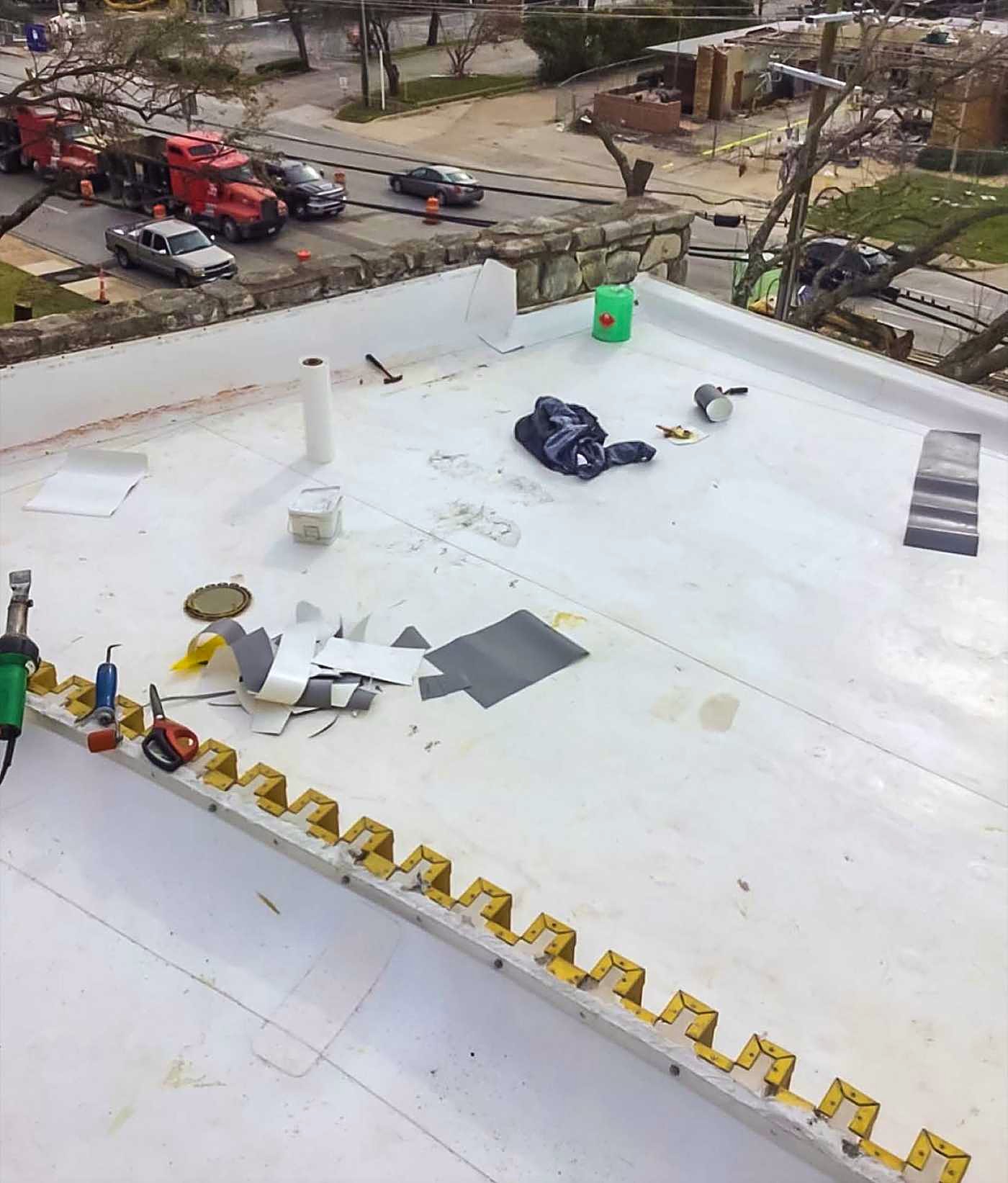
Thermoplastic polyolefin is a single-ply sheet, rolled out and hot-air welded at every seam so the finished roof is effectively continuous. It is normally white, and on a Texas building that is worth real money: a reflective roof runs far cooler than a dark one, which shows up in cooling load and in how hard the rooftop units have to work.
What decides whether a TPO roof performs is the thickness of the sheet and the quality of the welds, not the brand on the roll. A thin membrane welded quickly over damp insulation can fail in a few years. A properly specified one lasts decades.
PVC: for roofs that take grease
Polyvinyl chloride is the other thermoplastic single-ply and it is welded the same way. It costs more, and the reason to pay it is chemical resistance. Animal fats and oils attack TPO and will soften and eventually destroy the membrane downwind of a kitchen exhaust fan, and the same goes for buildings where solvents vent to the roof.
If the building has a restaurant in it, the decision is essentially made. If it does not, TPO usually gets there for less.
Modified bitumen: tough where people walk
Modified bitumen is asphalt with polymer modifiers, in sheets applied in two or more plies, either torch-applied or self-adhered. It is the descendant of the old built-up tar and gravel roof and it behaves like one: heavy, thick and forgiving of foot traffic in a way a single-ply sheet is not.
That makes it a good choice where maintenance staff are on the roof often, and on roofs with a great deal of complicated detail, because the plies can be worked around awkward shapes more easily than a welded sheet. A granulated cap sheet gives it a surface that stands up to sun and to boots.
The decision is mostly about the building, not the membrane
Four things decide it in practice. What is on the roof: a kitchen exhaust points at PVC. How much foot traffic it takes: heavy traffic points at modified bitumen. How long the owner intends to hold the building: a short hold justifies less membrane than a twenty-year hold does. And what is under the existing roof, because saturated insulation has to come out whatever goes on top, and that cost usually dwarfs the difference between the three systems.
Drainage sits underneath all of it. A roof that ponds will find the weakness in any of these three, so tapered insulation and working drains matter more than the choice between them.
Related questions
Can a coating go over my existing flat roof?
Over a sound membrane and dry insulation, often yes. Over wet insulation, no, because the moisture underneath has nowhere to go and gets sealed in.
Why is there water still sitting on my roof two days after rain?
Either there was never enough slope to the drains, the insulation has compressed, or a drain is blocked. Ponding loads the deck, finds marginal seams, and is an exclusion on a lot of membrane warranties.
How do I know if the insulation under my roof is wet?
A core cut is the definitive answer and infrared scanning gives a picture of where to take one. It is worth doing before a replacement, because the state of the insulation drives most of the cost.
Is a white roof worth it in Texas?
On a cooling-dominated building, yes. Most of the year here is spent trying to keep heat out rather than in, so reflectivity works in your favor nearly every month.